
Before starting any construction, renovation, or refurbishment project, one critical question must always be answered: is asbestos present in the building? Identifying Asbestos Before Work Begins.
For project owners, this is not only a technical requirement but a legal obligation and a fundamental safety responsibility. Across the European Union and the United Kingdom, asbestos regulations require that risks are identified and assessed before any work begins, not during construction.
Legal requirement to identify asbestos before works
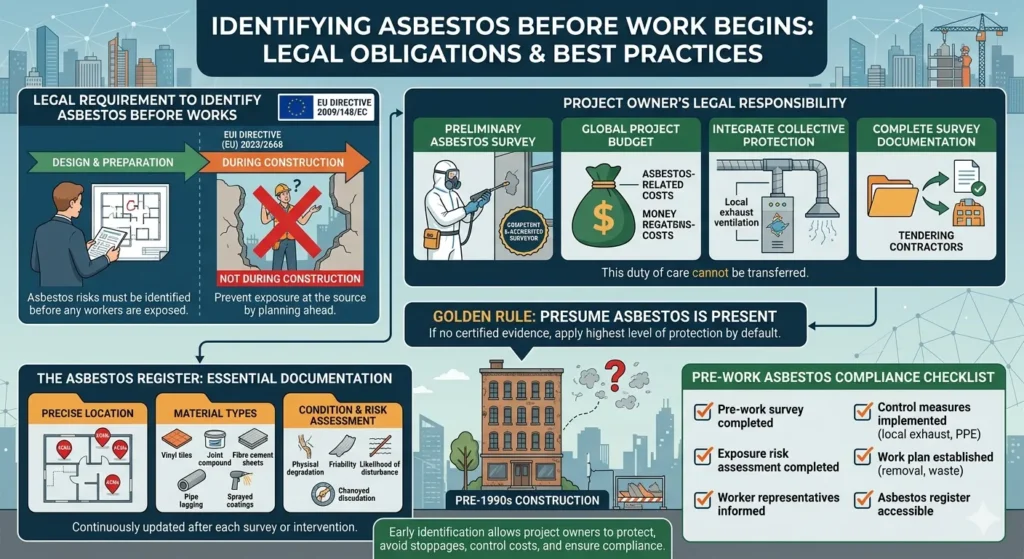
European legislation, including the Directive 2009/148/EC, strengthened by Directive (EU) 2023/2668, establishes a clear obligation: asbestos risks must be identified before any workers are exposed.
This requirement applies during the design and preparation phase of a project, meaning before:
- contractors are selected,
- budgets are finalized,
- or demolition and refurbishment work begins.
The objective is simple: prevent exposure at the source by planning ahead.
The project owner’s legal responsibility
The responsibility for asbestos identification lies with the project owner (client). This duty of care cannot be transferred to contractors.
In practical terms, the project owner must:
- commission a preliminary asbestos survey performed by a competent and accredited surveyor,
- ensure asbestos-related costs are included in the global project budget,
- integrate collective protection measures into project planning,
- provide all tendering contractors with complete survey documentation.
Without this information, contractors cannot properly assess risks or plan safe working methods.
The golden rule: presume asbestos is present
A key principle applies in asbestos management:
If there is no certified evidence confirming absence, asbestos must be presumed present.
This precautionary rule applies especially to buildings constructed before national asbestos bans, which in most European countries occurred before the late 1990s.
This means:
- the highest level of protection must be applied by default,
- no assumption of safety can be made without laboratory confirmation,
- risk reduction measures are only permitted after certified analytical results.
This conservative approach is essential to prevent accidental exposure to asbestos fibres, which can be released when materials are disturbed.
The asbestos register: essential site documentation
The asbestos register is a central document in any compliance strategy. It must be continuously updated after each survey or intervention.
It typically includes three essential components:
1. Precise location of materials
The register must include detailed plans showing exactly where asbestos-containing materials (ACMs) are located within the building.
2. Identification of material types
Common ACMs include:
- vinyl floor tiles,
- joint compounds and sealants,
- fibre cement sheets,
- pipe insulation (lagging),
- sprayed coatings and fireproofing materials.
3. Condition and risk assessment
Each material must be evaluated in terms of:
- physical degradation,
- friability (ability to release fibres),
- likelihood of disturbance during works.
This document is essential for planning safe interventions and ensuring that all stakeholders understand site risks.
Pre-work asbestos compliance checklist
Before any work begins, project owners must ensure that all regulatory and safety requirements are met.
✔ Pre-work survey completed
Has a full asbestos survey been conducted by a certified and competent professional covering the entire scope of works?
✔ Exposure risk assessment completed
Has the risk been evaluated for both:
- workers directly exposed on site,
- occupants or nearby individuals indirectly exposed?
✔ Worker representatives informed
Have employee representatives been consulted and informed of:
- survey findings,
- risk levels,
- protective measures?
✔ Control measures implemented
Are control measures compliant with occupational exposure limits, including:
- local exhaust ventilation systems,
- appropriate personal protective equipment (PPE)?
✔ Work plan established
Does the plan include:
- detailed work phases,
- asbestos removal or management strategy,
- waste handling procedures,
- emergency response protocols?
✔ Asbestos register accessible
Is the asbestos register available and reviewed by all contractors and maintenance personnel before work begins?
Why early asbestos identification matters
Proper asbestos identification is not just about regulatory compliance. It is a core project risk management tool.
Early identification allows project owners to:
- protect workers and building occupants,
- avoid unexpected site stoppages,
- control and anticipate remediation costs,
- ensure full legal compliance throughout the project lifecycle.
In today’s European construction and renovation context, where building refurbishment is accelerating, asbestos management must be integrated from the very beginning of the project cycle.
Conclusion
Identifying asbestos before work begins is a mandatory step in any responsible construction or renovation project.
By applying a structured approach — survey, register, risk assessment, and planning — project owners ensure compliance, safety, and cost control.
Early asbestos identification is no longer optional: it is a fundamental requirement for safe and modern construction management.