
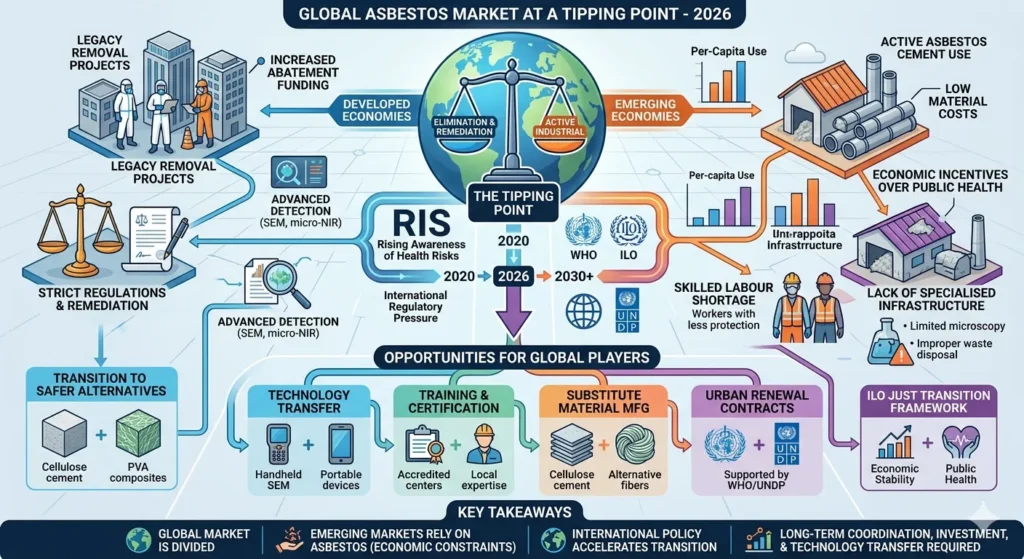
In 2026, the global asbestos market landscape remains deeply divided. In many developed economies, asbestos is mainly treated as a legacy hazard that must be identified, managed, removed or safely contained. In other parts of the world, asbestos-containing materials are still used, particularly where low-cost construction products remain in demand.
This contrast creates a complex global situation. Public health concerns, stricter regulations, international guidance and growing demand for safer materials are reshaping the way asbestos is managed. However, progress remains uneven from one region to another.
A divided global asbestos landscape
The asbestos market no longer follows a single global trajectory.
In countries where asbestos has been banned or heavily restricted, the main challenge is legacy management. This includes asbestos surveys, risk assessment, abatement, waste management, worker protection and long-term building compliance.
In countries where asbestos is still used, the challenge is different. Asbestos-containing materials, especially asbestos-cement products, may continue to be selected because they are affordable, durable and widely available.
As a result, the global asbestos sector in 2026 sits between two realities: removal and remediation in regulated markets, and continued use in countries where alternatives are not yet fully accessible or economically competitive.
Why asbestos remains a global public health issue
Asbestos exposure is associated with serious diseases, including mesothelioma, lung cancer, laryngeal cancer, ovarian cancer and asbestosis. These risks are well documented by international health authorities.
The World Health Organization considers stopping the use of all forms of asbestos to be the most effective way to eliminate asbestos-related diseases. However, asbestos-related risks do not disappear once a ban is introduced. Buildings, infrastructure and industrial facilities constructed before national restrictions may still contain asbestos for decades.
This is why both countries that have banned asbestos and countries that still use it face long-term asbestos management challenges.
Key challenges in emerging and developing markets
1. Economic pressure and material affordability
In some markets, asbestos-cement products remain attractive because of their low cost and established supply chains. For households, public authorities and small construction companies operating under budget constraints, safer alternatives may be harder to access or more expensive.
This creates a difficult public health challenge. Even when the risks of asbestos are known, economic pressures can slow the transition to non-asbestos materials.
2. Limited testing and monitoring capacity
Effective asbestos management requires reliable identification of asbestos-containing materials and proper exposure monitoring. In some countries, access to specialised laboratories, trained analysts and advanced fibre-counting methods may be limited.
When testing capacity is insufficient, asbestos risks can be underestimated. This can affect workers, building occupants and communities living near demolition, renovation or waste disposal sites.
3. Waste management and disposal constraints
Safe asbestos removal is only one part of the process. Once asbestos-containing materials are removed, they must be packaged, transported, traced and disposed of in appropriate facilities.
In regions with limited hazardous waste infrastructure, asbestos waste management can become a major problem. Poor handling, informal disposal or uncontrolled dumping can create long-term environmental contamination and secondary exposure risks.
4. Shortage of trained asbestos professionals
Asbestos work requires specific skills, procedures and protective equipment. Workers need to understand how to prevent fibre release, use respiratory protection correctly, establish controlled work zones and manage contaminated waste.
Where training systems are weak or equipment is limited, removal activities may themselves create exposure risks. This makes capacity-building a central issue for countries seeking to improve asbestos safety.
Opportunities for asbestos management and abatement players
Despite these challenges, the global asbestos transition also creates opportunities for qualified companies, technology providers, training organisations and public authorities.
Technology transfer
There is growing demand for practical tools that can improve asbestos detection, documentation and risk management. Portable screening technologies, digital survey tools, remote documentation systems and improved sampling workflows can support countries where laboratory infrastructure is still developing.
These technologies do not replace accredited laboratory analysis where it is legally required, but they can help improve decision-making, prioritisation and field operations.
Training and certification
Training is one of the most important areas for improvement. Accredited training centres, local certification schemes and international knowledge transfer can help develop a skilled workforce capable of managing asbestos risks safely.
This includes training for surveyors, removal workers, supervisors, waste handlers, public authorities and building owners.
Safer substitute materials
The transition away from asbestos also creates opportunities for manufacturers of safer construction materials. Fibre-cement products using non-asbestos fibres, polymer-based composites and other alternative materials can reduce reliance on asbestos-containing products.
For these alternatives to scale, they must be technically reliable, locally available and economically competitive.
Public infrastructure and urban renewal
Asbestos management is increasingly linked to renovation, infrastructure renewal and public building safety. Schools, hospitals, social housing, transport infrastructure and industrial sites may all require asbestos surveys and, where necessary, remediation work.
For qualified contractors, this creates long-term demand for asbestos expertise, especially where governments and international organisations support safer building renovation programmes.
The role of international policy
International organisations continue to play an important role in shaping asbestos policy, worker protection and public health guidance.
The World Health Organization supports the elimination of asbestos-related diseases and highlights the importance of ending the use of all forms of asbestos. The International Labour Organization provides standards and guidance related to occupational exposure and worker protection.
In parallel, development agencies and environmental organisations contribute to safer hazardous waste management, emergency response guidance and capacity-building in countries facing asbestos-related risks.
These initiatives do not create a uniform global ban, but they help strengthen national asbestos policies and improve the technical capacity needed to manage the problem safely.
A market shaped by regulation, remediation and transition
In 2026, the global asbestos market is not simply expanding or disappearing. It is transforming.
In highly regulated markets, asbestos is mainly associated with inspection, remediation, compliance and waste management. In countries where asbestos is still used, the market remains connected to construction demand, affordability and industrial supply chains.
This creates a long transition period. The future of the asbestos sector will depend on how quickly countries can improve regulation, expand access to safer materials, train workers and build reliable waste management systems.
Conclusion
The global asbestos market in 2026 stands at a critical point. Developed economies are focused on managing legacy asbestos, while some emerging markets still face continued use, limited infrastructure and affordability challenges.
For governments, the priority is clear: reduce exposure, strengthen regulation and support the transition to safer alternatives. For industry stakeholders, the opportunity lies in responsible asbestos management, technology transfer, training and the development of non-asbestos materials.
Asbestos is no longer just an industrial material issue. In 2026, it remains a global public health, construction, environmental and development challenge.