
Passive and Secondary Asbestos Exposure: Two Overlooked Realities
Asbestos risk is often associated with direct occupational exposure. However, two critical but frequently underestimated forms of exposure exist: passive exposure and secondary exposure.
These exposure pathways have contributed significantly to long-term health impacts, including cases of mesothelioma in individuals with no direct contact with asbestos materials.
Understanding these risks is essential for improving workplace safety and protecting the wider population.
Passive asbestos exposure: indirect risk in the environment
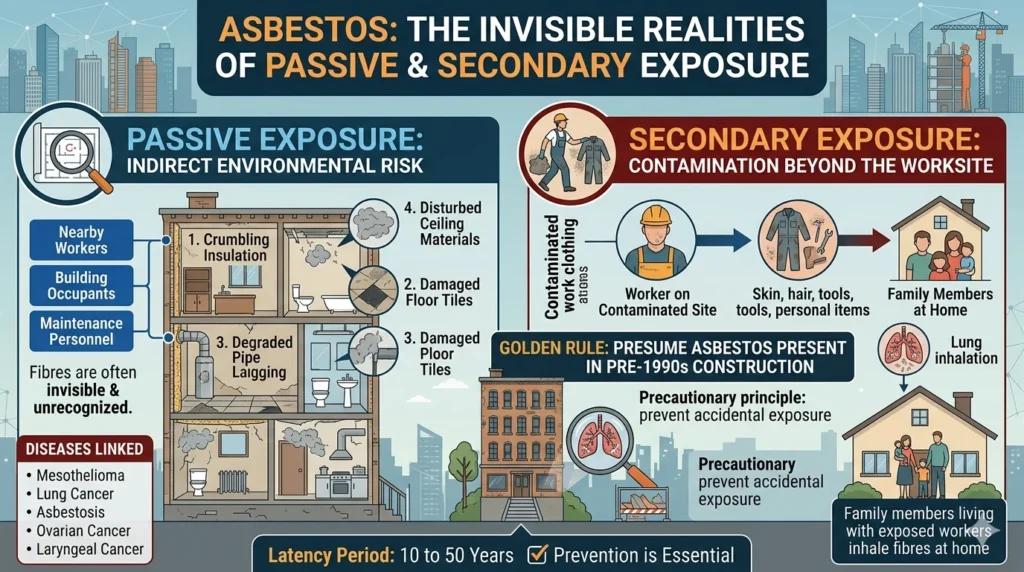
Passive exposure occurs when individuals are exposed to asbestos fibres without directly handling asbestos-containing materials (ACMs).
This typically affects:
- workers operating near renovation or demolition zones,
- occupants of buildings where asbestos materials are deteriorating,
- maintenance personnel in older infrastructures.
Common sources include:
- crumbling insulation,
- damaged floor tiles,
- degraded pipe lagging,
- disturbed ceiling materials.
Even without direct intervention, fibres can become airborne when materials are disturbed by vibration, aging, or environmental conditions.
👉 Passive exposure is particularly dangerous because it is often invisible and unrecognized.
Secondary asbestos exposure: contamination beyond the workplace
Secondary exposure occurs when asbestos fibres are unintentionally carried outside the worksite.
This can happen through:
- contaminated work clothing,
- skin and hair,
- tools and personal items.
As a result, family members of exposed workers may inhale fibres at home.
Historical medical studies have documented cases of mesothelioma in individuals who:
- never worked in construction,
- never entered contaminated sites,
- but lived with exposed workers.
👉 This demonstrates that asbestos risk extends beyond occupational environments into domestic life.
A long latency period: 10 to 50 years
One of the most critical characteristics of asbestos-related disease is its extremely long latency period.
Asbestos is classified as a biopersistent carcinogen, meaning:
- inhaled fibres remain in lung tissue indefinitely,
- the body cannot fully eliminate them.
The latency period between exposure and disease development typically ranges from:
10 to 50 years
This means that:
- exposures from the 1970s–1980s construction boom are still causing diagnoses today,
- health impacts continue long after exposure has ended.
Diseases linked to asbestos exposure
Long-term exposure to asbestos fibres is associated with several serious diseases, including:
- mesothelioma
- lung cancer
- asbestosis
- ovarian cancer
- laryngeal cancer
👉 These conditions often develop silently over decades, making early prevention essential.
Case study: heritage building exposure incident
A notable example occurred during the renovation of a 1905 heritage building in the Netherlands.
During works on a glass dome structure:
- previously unidentified asbestos-containing materials were discovered beneath a secondary protective layer,
- the presence of hidden ACMs was not detected in initial planning stages.
Immediate consequences:
- work was stopped immediately,
- adjacent office spaces were temporarily isolated,
- containment measures were implemented to prevent airborne fibre spread.
👉 This case highlights the importance of thorough pre-renovation asbestos surveys, especially in historic buildings.
Preventing asbestos exposure in the workplace
Effective prevention relies on early identification, monitoring, and strict procedural controls.
Material degradation indicators
Workers and site managers should watch for:
- crumbling insulation,
- broken or damaged floor tiles,
- deteriorated pipe lagging,
- disturbed ceiling materials.
These are often early signs of potential asbestos release.
Suspicious dust formation
Fine particulate dust may appear after:
- drilling or cutting,
- vibration near structural elements,
- water infiltration into older materials.
Such dust should always be treated as potentially hazardous until verified otherwise.
Asbestos register consultation
Every commercial or public building should maintain an up-to-date asbestos register.
This document must:
- identify all known asbestos-containing materials,
- describe their location and condition,
- be accessible to contractors and maintenance teams before work begins.
👉 It is a key legal and operational safety tool.
Pre-renovation asbestos surveys
No renovation or demolition work should begin without:
- a professional asbestos survey,
- conducted by an accredited and competent inspector.
This ensures that hidden risks are identified before any disturbance occurs.
Key takeaway
Asbestos exposure is not limited to direct handling. Both passive and secondary exposure represent serious and often underestimated health risks.
Combined with the long latency period of asbestos-related diseases, these exposure pathways highlight the importance of:
- early detection,
- strict site controls,
- and comprehensive risk assessment before any work begins.
Conclusion
Preventing asbestos exposure requires a broader understanding of risk beyond the construction site.
By addressing passive exposure, secondary contamination, and historical building risks, organisations can significantly reduce long-term health consequences.
In modern construction and renovation environments, asbestos safety is not only a regulatory requirement — it is a fundamental responsibility toward workers, families, and the public.